

Do you tend to THINK about your feelings?
Most of us were taught to. When something hurts, we go looking for the reason. We trace the pattern back to where it started, figure out who implanted the story and when, and give it a name. People pleasing. Perfectionism. Fear of abandonment. Then we wait for the relief that’s supposed to come with knowledge and understanding.
Except it rarely comes. Getting smarter by itself doesn’t resolve the emotions that are shaping the stories that are shaping your life. Knowing where the stories came from, who implanted them, and when they were implanted won’t heal the hurt or help you change the story. So those same feelings sneak up again. They don’t care if you think you understand. They want to feel seen and heard – just like you do. That’s because they are you.
So you end up having the same old fights in the same old situations. You fall back into people pleasing or perfectionism, blame or irritation, social anxiety masquerading as class clown. You feel like a stranger to yourself, homeless in your own life. And because you understand the pattern so well, it’s tempting to add one more charge to the list: I know better, so why do I keep doing this?
The reason your patterns keep repeating isn’t that you don’t understand them enough. What’s really happening is that the emotions underlying them haven’t been duly noticed, experienced, or processed. Instead, they’ve been suppressed, pushed away, negated, or ignored, and they’re clamoring to feel seen and heard. They have something important to teach or tell you. Think of them as messengers full of wisdom and guidance. Once they’ve delivered their message, they’ll move on of their own accord.
Why thinking comes too late
Here’s what conventional wisdom misses: our experiences don’t start in our thoughts. Emotions are a physiological experience, neutral information about what’s happening inside and around us. They morph into feelings so fast that we often use the two words interchangeably, even though those feelings are the beginnings of the stories we tell ourselves about what an experience means and what it says about us. Those feelings get translated into words, the words become thoughts, and the thoughts settle into our stories, patterns, and beliefs.
By the time you’re thinking about a feeling, the story has already started. Changing the thought works on the surface while the feeling underneath stays in charge. That’s why a new perspective arrives only after the feeling has been felt through – not before, and not instead.
Why thinking feels safer
So if feeling is what works, why do we keep reaching for our heads? Psychology has a name for it. Intellectualization is a defense mechanism that replaces raw, unpredictable emotional experiences with detached logic, analysis, and order. We want to believe it protects us from overwhelm, vulnerability, and painful past experiences.
It doesn’t protect us. It postpones. And postponing costs.
In her research on rethinking rumination, psychologist Susan Nolen-Hoeksema found that repeatedly mulling over why we feel bad, and what it means, tends to deepen and prolong distress instead of relieving it. Picture it like digging a mental trench deeper and deeper until it feels impossible to climb out. Thinking about a feeling feels productive because we’re doing something. Meanwhile, the feeling waits, digs, and keeps knocking until we answer.
None of this makes thinking the enemy. Thinking, understanding, and intellectualizing are mind skills – important, but not the key to changing your inner narratives or healing your wounds. Feeling is an emotional skill, and it’s the key to reshaping the internalized stories that have been running your life from the background.
What makes feeling safe enough
Feeling through an emotion feels safe when your emotional system recognizes that the feeling will not destroy you, reject you, or require you to perform.
That last one deserves a second look. People pleasing is a performance. So is perfectionism. So is the class clown. Each one keeps us busy so the feeling never gets its turn, and each one teaches our emotional system that feelings are dangerous unless they’re managed.
According to the NIH, your emotional system works inside your nervous system, your body’s command center, creating and processing your feelings and your survival responses, like fight, flight, freeze, or fawn. It doesn’t learn safety from an explanation. It learns from experience: a feeling shows up, gets felt, and passes. And you’re still here. Each time that happens, the next feeling becomes a little easier to allow.
Feeling through doesn’t mean drowning in a feeling, and it doesn’t mean reliving every hurtful memory. It often begins with something as simple as naming what’s there. In a UCLA brain-imaging study, Matthew Lieberman and his colleagues found that putting feelings into words reduced activity in the amygdala, the brain’s alarm center. Naming isn’t analyzing. It’s acknowledging. “I’m angry” lets the feeling know it’s been heard. “Why am I like this?” sends it back to wait.
Catch yourself thinking it through
Most of us don’t notice when we’ve swapped feeling for figuring out, but our words give us away. Here’s what each one sounds like:
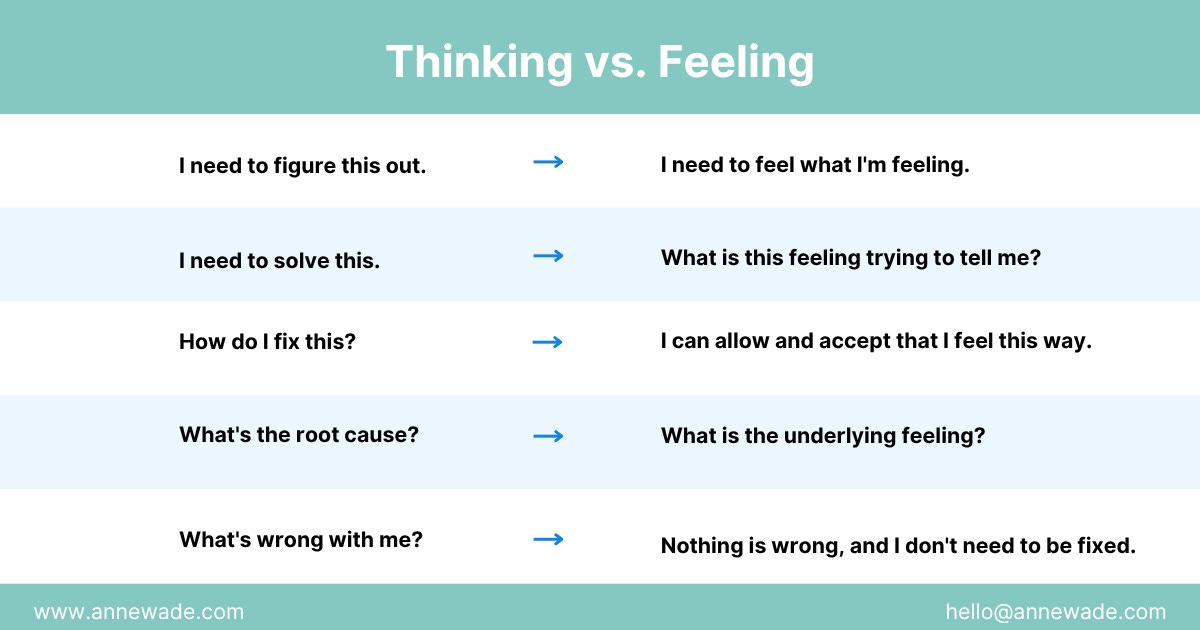
A lot of well-meaning coaches and programs teach you how to change your thoughts, think more, think positive, think. (If you missed it, The Lethal Catch in Thinking Positive looks at what happens when positive thinking becomes a place to hide.) StoryShift teaches you how to feel through the feeling so the patterns and triggers can stop.
Reflection: Catch the Swap
The next time you hear yourself say “I need to figure this out,” pause before the swap. Name the feeling you were about to think your way around. No fixing, no root cause. Just notice what you almost traded for an explanation.

P.S. — If you’re asking “what do I do now,” the StoryShift Quiz is where I’d start. The patterns that once kept you safe may now be holding you back. In less than five minutes, get personalized feedback on whether old patterns might still be shaping your life today: StoryShift Quiz.