

No…
It’s such a tiny word, but it packs a lot of power. “No” is the ultimate boundary. The line that will not be crossed. Though small in size, its weight can reshape reality, stop momentum, change dynamics, and bring circumstances and relationships to a screeching halt. It can create endings and can also open up space for new – and potentially more meaningful – beginnings.
“No” can be one of the hardest words to say as an adult, and yet we said it easily as toddlers. It may have been a favorite word, right up there beside “why.” But that was before…
As a Baby Boomer woman raised in the Deep South, the conditioning and culterizing against saying “no” began at birth. By the time we were toddlers and becoming verbal, we’d been well-taught that our favorite word was also a bad word. Saying “no” was rude, disrespectful. Avoiding conflict, maintaining harmony and being nice and polite were the top priorities. In those times in that place, it was better to say nothing than to say “no.”
It was not – and is not – unique to that time and place.
The inability to say “no” is often rooted in people-pleasing, fear of disappointing, fear of conflict, or even fear of punishment. The potential for damage and danger can be real and wide spreading – overcommitment, burnout, resentment, and the inability to make clear decisions. Your silence can be taken for acquiesce or agreement.
Because saying “no” can be challenging, it lends itself to Pleasant Platitudes – those quick, emotional band-aids we use when we don’t know what to say or we want to smooth over an awkward situation, manage our own discomfort, or insert an approved comment. “Everything happens for a reason.” “She’s in a better place.” Those who fall back on them usually mean well. In the case of “no,” we can even be a bit smug reassuring friends and strangers that “ ‘No’ is a complete sentence.” But is it?
Is “No” a Complete Sentence?
I’ve said those exact words. Maybe you have, too. Grammatically it’s correct, and on the surface, the simple psychology is accurate. But scratch just beneath the surface and it’s a different story. Underneath the veneer of any Pleasant Platitude, it’s messy, human and emotionally complex.
Here’s the real kicker. Have you ever paused to consider how that phrase feels to the recipient? My answer? I haven’t taken that pause nearly often enough.
It can feel like a blanket statement:
-
Dismissive
-
Oversimplified
-
Unhelpful
-
Mean
-
Bitchy
-
Abrupt
-
Judgmental
-
Condescending
-
Cold
The phrase frequently overlooks several critical nuances of emotional intelligence:
-
Ignores context.
-
Sidesteps listening.
-
Sounds preachy.
-
Lacks empathy.
The recipient may feel they are supposed to show gratitude for that cliched “wisdom” to avoid hurting our feelings even though they feel neither seen nor heard. It may even confirm their suspicions that saying “no” is bad.
And yet, being able to say “no” simply, clearly, and unapologetically is fundamental to setting and tending boundaries.
When “No” By Itself IS Complete
The thing about musing on something is that “suddenly” examples are everywhere.
I was in the hospital a couple of weeks ago with a raging infection, a common risk with chemo. The infection had responded well to the IV antibiotic and it was finally safe to let me go home and finish on oral antibiotics.
Yay!
Not so fast. My medical record clearly states I am allergic to a certain class of antibiotics. The nurses re-validated that right along with my address and birthday. Every single time they did anything.
As the discharge nurse went over the paperwork, she listed the take-home prescriptions.
“What? No!” The discharge script was in the forbidden class. All that checking and no one had actually caught it. “No” was definitely a complete sentence.
Sometimes we do need to consider the recipient. And sometimes we need to put our own needs first.
Saying “no” is an act of self-preservation, not selfishness.
Which brings us to “The Bagpipe who Didn’t say No”
This lesser-known poem by Shel Silverstein tells the story of a lovestruck turtle who gets so carried away in his own desires that he misinterprets a bagpipe’s silence as consent. On the surface, it’s nonsensical and silly. But scratch that surface just a bit and the parable is clear.
The turtle and bagpipe meet on the beach. The turtle asks to sit with the bagpipe. The bagpipe is just minding its own business and doesn’t say no.
Emboldened by the silence, the turtle’s requests escalate. The bagpipe still doesn’t say no.
The turtle, who has by now escalated himself, grabs the bagpipe in an over-enthusiastic hug that finally squeezes out a sound – a bagpipe sound that the turtle interprets as rejection. The turtle slinks away in tears.
The poem reads like a nursery rhyme, though it’s hiding a cautionary tale.
Notice that the turtle asks for reassurance, but the bagpipe remains silent. Silence can too often be mistaken for consent.
If you never say “no,” people might take your silence as a “yes” and do whatever they want, assuming you’re on board. Self-silencing can be damaging or dangerous.
The real power comes from learning When to Say Yes and How to Say No.
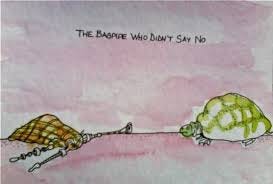
The Bagpipe Who Didn’t Say No
by Shel Silverstein
It was nine o’clock at midnight at a quarter after three
When a turtle met a bagpipe on the shoreside by the sea,
And the turtle said, “My dearie,
May I sit with you? I’m weary.”
And the bagpipe didn’t say no.
Said the turtle to the bagpipe, “I have walked this lonely shore,
I have talked to waves and pebbles–but I’ve never loved before.
Will you marry me today, dear?
Is it ‘No’ you’re going to say dear?”
But the bagpipe didn’t say no.
Said the turtle to his darling, “Please excuse me if I stare,
But you have the plaidest skin, dear,
And you have the strangest hair.
If I begged you pretty please, love,
Could I give you just one squeeze, love?”
And the bagpipe didn’t say no.
Said the turtle to the bagpipe, “Ah, you love me. Then confess!
Let me whisper in your dainty ear and hold you to my chest.”
And he cuddled her and teased her
And so lovingly he squeezed her.
And the bagpipe said, “Aaooga.”
Said the turtle to the bagpipe, “Did you honk or bray or neigh?
For ‘Aaooga’ when your kissed is such a heartless thing to say.
Is it that I have offended?
Is it that our love is ended?”
And the bagpipe didn’t say no.
Said the turtle to the bagpipe, “Shall I leave you, darling wife?
Shall I waddle off to Woedom? Shall I crawl out of your life?
Shall I move, depart and go, dear–
Oh, I beg you tell me ‘No’ dear!”
But the bagpipe didn’t say no.
So the turtle crept off crying and he ne’er came back no more,
And he left the bagpipe lying on that smooth and sandy shore.
And some night when tide is low there,
Just walk up and say, “Hello, there,”
And politely ask the bagpipe if this story’s really so.
I assure you, darling children, the bagpipe won’t say “No.”